A Retrospective on Product Recruiting
Note: This is a private rough draft. It's a reflection on college, recruiting, and what I think actually matters going forward, compressed into one longer piece for those who know they're interested in product. It covers a lot of ground and doesn't always connect the dots for you.
Spring of my freshman year, I took an inductive logic class that rewired something in me. I was a business major already bored with my coursework, studying something I didn't really want to. This class was different. I remember reading every page of that textbook, doing every problem, just because I found it genuinely interesting. My business classes, even the quasi-technical ones, were attempts to teach whatever skill happened to be in demand that semester. "R is in demand right now." "RAG is relevant, so here's how to use RAG." They never went deep enough on the thing that actually matters: how to think. How to solve problems you haven't seen before. And the stuff they deemed relevant was already being replaced by the time the course came out.
That logic class led me to pick up a philosophy minor, which turned into nearly completing the major. Phil of Mind, Aesthetics, Logic. I learned more in those courses about how to think about the world than in all of my business coursework combined. That class was the door.
I'm a senior at UT Austin finishing a data science degree, and I've been spending a lot of time lately reflecting on college. On recruiting, on what I spent my time on, and on what I wish I'd done differently. I spent two years recruiting for PM and was lucky enough to land offers at Coinbase, Salesforce, Datadog, and HashiCorp, with final rounds at Google and Databricks. Underclassmen ask me for advice constantly. I don't really have advice, not in the traditional sense. All of that is commoditized online and synthesized beautifully by AI. What I have is a perspective on what actually matters going forward, which turns out to be almost nothing like what PM recruiting selects for.
What's happening to PM
Something strange has been happening to product management. A few years ago, Brian Chesky told an audience at Figma's Config that Airbnb had "gotten rid of the classic product management function." Parts of the crowd cheered. He later walked it back: they'd merged PM with product marketing, Apple-style, elevating designers alongside engineers. The nuance got buried. "Product is dead" trended. It's easy to dismiss that as a misread, but the sentiment landed because it named something real: a lot of what PMs do is process theater. Stakeholder alignment decks, prioritization rituals, meetings about meetings. An elaborate system that exists mostly to justify its own existence. And yet:

Both sides are correct. The hated PM writes tickets and runs standups. The needed PM actually thinks. From the outside at least, recruiting seems to select for the first type: case studies, STAR stories, buzzword fluency, all proxies for process competence rather than the ability to decide what matters and why.
Something nobody says out loud: a lot of success in big-tech PM is politics. Not strategy, not product sense. The ability to navigate stakeholders across a ten-thousand-person org. Some people are genuinely good at that and find it energizing, and if that's you, wonderful. But be honest about whether that's what you actually want, or whether you're following the herd into the job everyone told you to want.
Look at the people fifteen years above you on whatever path you're on. Do you want to be them? Not abstractly. Concretely: their day-to-day, their problems, their relationship to the work. When I ran this on big tech, I couldn't even see myself being the people two or three years above me. Not because they weren't talented. They were. But the shape of their work, the meetings, the alignment docs, the politics, it just wasn't what I wanted my life to look like. That realization didn't come from reading essays. It came from watching.
Part of why I felt that way is that the role itself is becoming something different from what those people signed up for. Marc Andreessen put it plainly: "Every coder thinks they can be a PM and designer... every PM thinks they can code and design... every designer knows they can be a PM and coder... and they're all kind of correct."
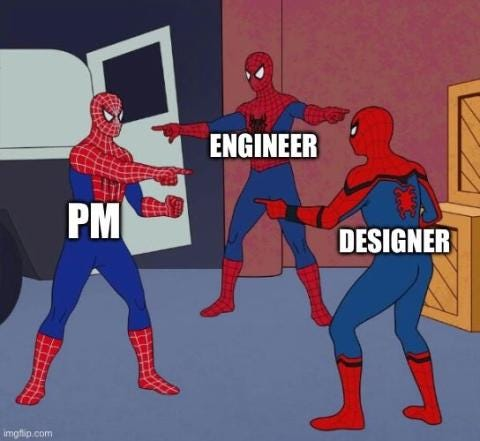
The key word is kind of. Any median-skilled person can now do sixty percent of what the median-skilled person in any adjacent role does, because AI closed the gap on execution. A PM can vibe-code a prototype, an engineer can generate decent UI, a designer can ship a working app. Roles aren't collapsing into one generic "builder." They're expanding into each other, the boundaries made visible as arbitrary. When execution is cheap, the bottleneck migrates: it's no longer who can build it, it's what should we build and why.
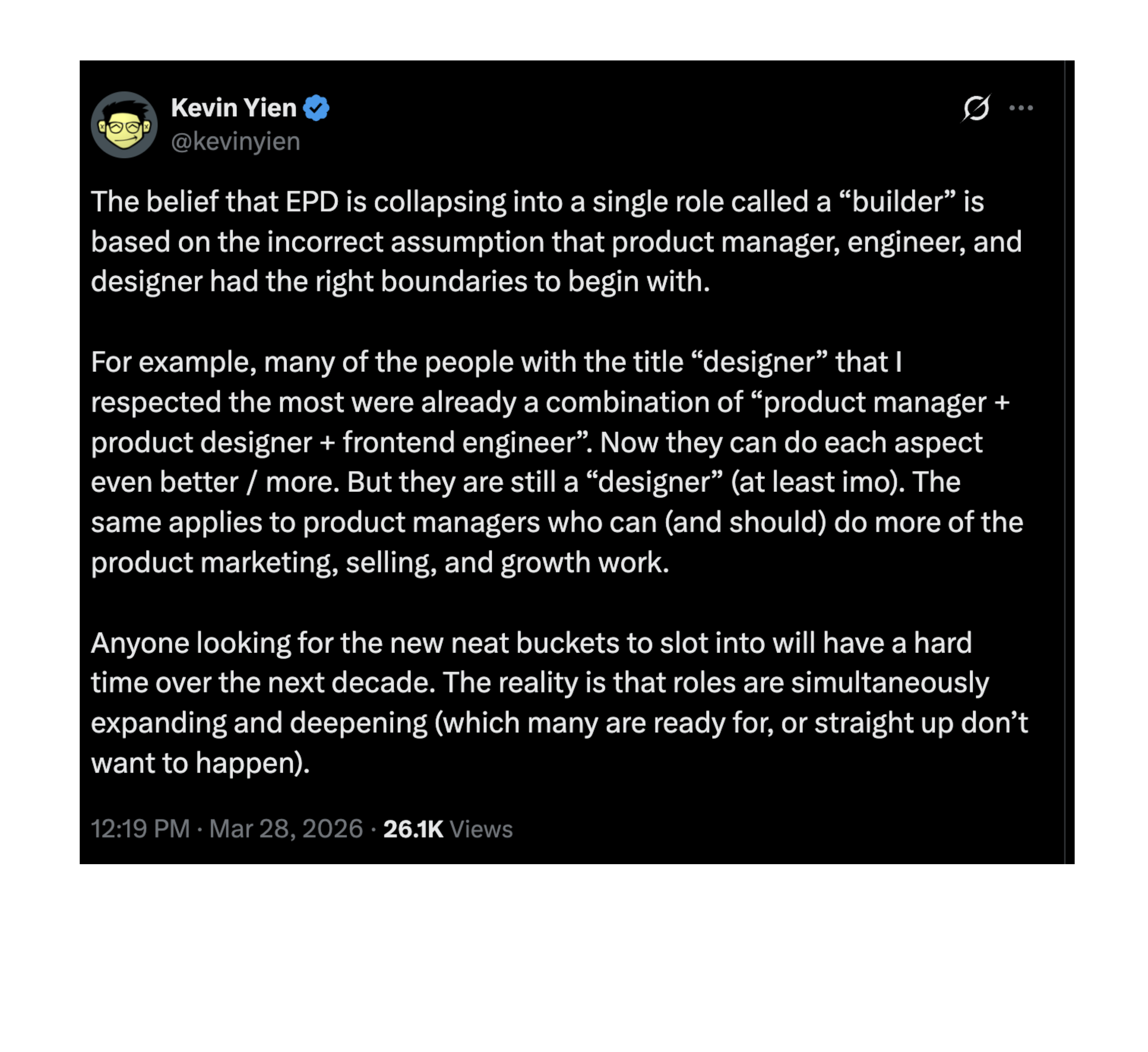
But there's a flip side to "everyone can execute," and I think it's the more important one:

"Think before you build" has always been true. What's new is that the cost of not thinking has collapsed to zero. StackOverflow made you work for your bad decisions. Claude gives you five hundred lines of confident, architecturally wrong code in four seconds. The speed of confident wrongness is the defining risk of this generation of builders. Most AI applications fail because they replicate old software patterns instead of reimagining what's possible. Someone called these "horseless carriages," and that metaphor has stuck with me. The same thing is happening to careers: "AI Product Manager" is a label that grafts a new technology onto an old structure and calls it innovation.
If the role is changing this fast, the question becomes: what's left that's durable?
Frameworks are a proxy for a proxy
Those courses did something my business classes never managed: they didn't teach me frameworks. They taught me how to break a thought down, pressure test it, say it clearly. The way I think about it, two things matter in product. Clarity and creativity. Creativity gives you interesting ideas; clarity lets you test them and explain them to other people. If you can do both, the frameworks are scaffolding you never needed. CIRCLES, RICE, whatever acronym is in vogue this semester: proxies for a proxy. A stand-in for structured thinking, which is itself a stand-in for the thing that actually matters, which is just the ability to reason. Those courses built that muscle directly. PM recruiting doesn't test for it at all.
I never really used the frameworks. I knew they existed, I'd seen the prep docs, but in actual interviews I mostly just explained my thinking directly. Broke the problem down, asked questions, reasoned through it out loud. It worked, and I think it worked because it wasn't a framework. Interviewers can tell the difference between someone pattern-matching their way through a case and someone actually thinking. Frameworks give you structure for the first five minutes. They can't carry you through the follow-up questions, where the interviewer pushes back and you have to reason on your feet, which is where it actually matters.
And increasingly, companies are making this explicit. LinkedIn killed their APM program and replaced it with live prototyping interviews. The question is shifting from "can you structure a case?" to "can you build something?" The gate itself is being replaced.
Focus

AI makes everything possible and nothing inevitable. You can build anything in a weekend, which means the hard part isn't building anymore: it's choosing what to build and ignoring everything else. Allocate your year optimally, not your day. We're addicted to junk information the same way we're addicted to junk food, the brain rewarding all of it equally regardless of usefulness, and the result is a generation of people who consume constantly and prioritize nothing.
Vibecoding suffers from exactly this. Everyone builds; barely anyone ships something that matters. The "how" has gotten cheap, which just shifts the burden onto the "what" and the "why," which is, and always has been, the actual job of product. If you're not intentional about those two questions before you open your laptop, you're producing noise at higher velocity than before.
Taste
Good taste objectively exists. Deny it and you have to deny that artists can improve, which is clearly false. Taste has two modes: exploratory and conviction. You find beauty, then you pursue it. You develop both by doing things without recipes, by attending carefully, by making thousands of small decisions over time. AI can't generate taste because taste requires caring about something specific, having a point of view rather than optimizing for the average of all points of view.
I took an upper-division aesthetics course last semester. Nothing to do with my degree. It taught me more about product thinking than I expected, because the central question, what makes something good rather than merely functional, turns out to be exactly the question that separates great products from adequate ones. What is beauty? Is our treatment of beautiful things different from our treatment of functional ones? What does it mean to have a considered opinion about quality rather than just a reaction? These aren't soft questions. They're harder than most of what I've been asked in PM interviews.
Ivan Zhao understood this intuitively. Cognitive science major, studied Chinese watercolor painting. When Notion nearly died in 2015, he moved to Kyoto and rebuilt the product from scratch, eighteen-hour days in Figma. Now it's worth over ten billion dollars. His aesthetic sense wasn't just the product strategy: it was the organizing principle for the entire company, visible in the office, the brand, the way the team thinks about what belongs and what doesn't. It came from a background most people in tech would have dismissed as irrelevant.
Systems thinking
We chronically misapply linear cause-and-effect to complex systems riddled with feedback loops, and every "X caused Y" in product hides more truth than it reveals.
Airbnb's growth team spent years optimizing conversion on the booking flow. More bookings, more revenue, clean linear logic. What they missed was the feedback loop: every marginal booking from a guest with a bad experience created a host with a bad experience, who left the platform or lowered their standards, which degraded supply quality, which made the next guest's experience worse. The system was eating itself through the very metric they were optimizing. Seeing that required asking "and then what?" three or four times past the point where the dashboard says you're winning.
My Phil of Mind course was where I first encountered that kind of demand: reasoning with precision at a high level of abstraction, where the thing you're analyzing resists easy reduction. Consciousness as an emergent property of simpler processes, mental states and physical states and the hard problem of what connects them. Math does this too. So does formal logic, certain corners of CS theory. The subject matters less than the experience of having to hold something genuinely complex in your head without collapsing it prematurely. That muscle, once built, transfers. Products, organizations, markets all behave the same way: the whole is nothing like the sum of its parts, and the levers are rarely where the dashboard says they are.
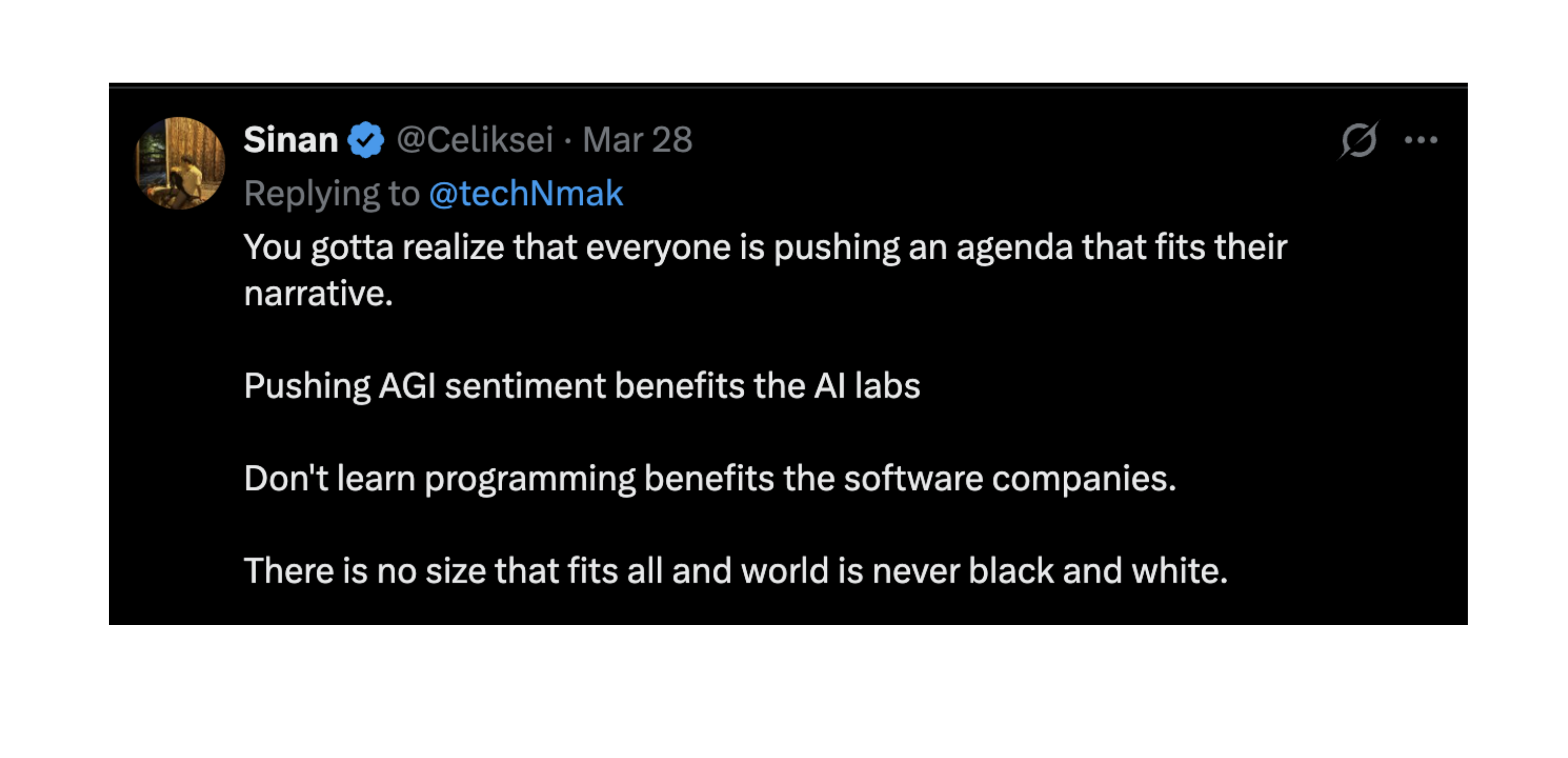
Apply this to how you read narratives too. When someone says "PMs are dead," ask who benefits from you believing that. When AI labs push AGI timelines, ask what it does for their fundraising. And when you can finally see the system clearly enough, you get access to something most people never develop: the ability to name a tension before anyone else has articulated it.

To collapse complexity into a direction. Not a roadmap, not a strategy doc; those an LLM can write. The tension that hasn't been named yet isn't in the training data. That's the job.
What to study

Every field, if you push far enough, turns out to rest on the one below it. The mathematician stands alone at the end of the line. Apply this to your education and a useful principle emerges: the more fundamental your knowledge, the more things it sits upstream of, and the harder it is for any paradigm shift to make it irrelevant. Physics sits upstream of electrical engineering, which sits upstream of computer science, which sits upstream of most applied tech. Philosophy sits upstream of reasoning itself. Statistics sits upstream of evaluating any claim in any domain.
Think about friction in one direction. A physics major can become a software engineer with relatively low friction because they understand, at a deep level, how we made sand think. The reverse is much harder. A PM who actually knows how to think can adapt to any paradigm shift. A PM who studied "product management frameworks" is stranded the moment those frameworks change.
You can almost draw it on two axes: hard versus soft, fundamental versus applied. The worst quadrant is soft and applied: organizational behavior, information systems, a lot of the MIS curriculum. MIS is mostly a collection of tools and whatever the industry happens to be using right now, which is best learned by just building anyway. The other fields in this quadrant have a deeper problem: their claims are often not falsifiable, which means there's no reliable way to tell signal from noise, and the void tends to get filled by whatever political agenda is in fashion. If you're going to spend time in a classroom, use it on the axiomatic stuff, the building blocks that everything else derives from. Not only does understanding those things equip you to spawn your own frameworks on demand, but the difficulty of learning them is itself the point. The reps that hard material forces on your brain are like heavy lifting: it just makes you sharper. You don't get that from learning tools. You get it from sitting with something genuinely hard until it clicks.
The specific subject matters less than the principle: take whatever genuinely interests you, as long as it's fundamental and difficult. Your university's shiny new "AI Product Management" elective is teaching RAG pipelines and prompt engineering, topics already less relevant than when the syllabus was written (trust me, I took it). Tech moves so fast that by the time a subject becomes a course, it's old news. Logic, probability theory, statistics: those compound for decades. Learn the things that don't change. Talk to your professors. Most students don't, and the ceiling on those relationships is vastly higher than anyone realizes.
The same 80/20 principle applies to how much you take. In CS, comparch, OS, data structures and algorithms, databases, and networking are maybe five percent of available courses but ninety percent of the value. The same distribution holds in most subjects. Unless you're headed toward a PhD or a highly specialized grad degree, you're better off taking the core four or five most valuable classes across the top three or four majors that cover your areas of interest. Even within those, optimize for B's and low A's rather than spending all your time chasing A-pluses. That's the sweet spot on both time and depth of exposure. The rest of your time should go into building projects, meeting people, and everything else college offers that a classroom can't. I think this is more of a solved problem than people let on, and less subjective than it feels. It's probably roughly the Pareto efficient frontier of the tradeoff between studying and doing.
My friends in physics, math, and low-level computer science have these same muscles built into their major, a curiosity about the thing itself rather than as a means to some job, and it shows. The choice you face, and it's becoming more extreme, is whether to go super deep in one area and be in the top one percent, or be in the top one percent at the intersection of several things. The middle is what gets commoditized: shallow generalism is exactly what AI does best. Product management is inherently generalist, so the intersection approach matters especially. You're never going to out-engineer the engineers or out-design the designers. The people who stand out will be the ones with unusual combinations of genuine depth, not resume-line depth, but the kind where you actually understand something well enough to see what others miss. The stranger and more genuine the combination, the harder it is to replicate.
Two archetypes
If you look at who actually made it to the top of product, you really only see two archetypes: the founder type and the ladder climber.
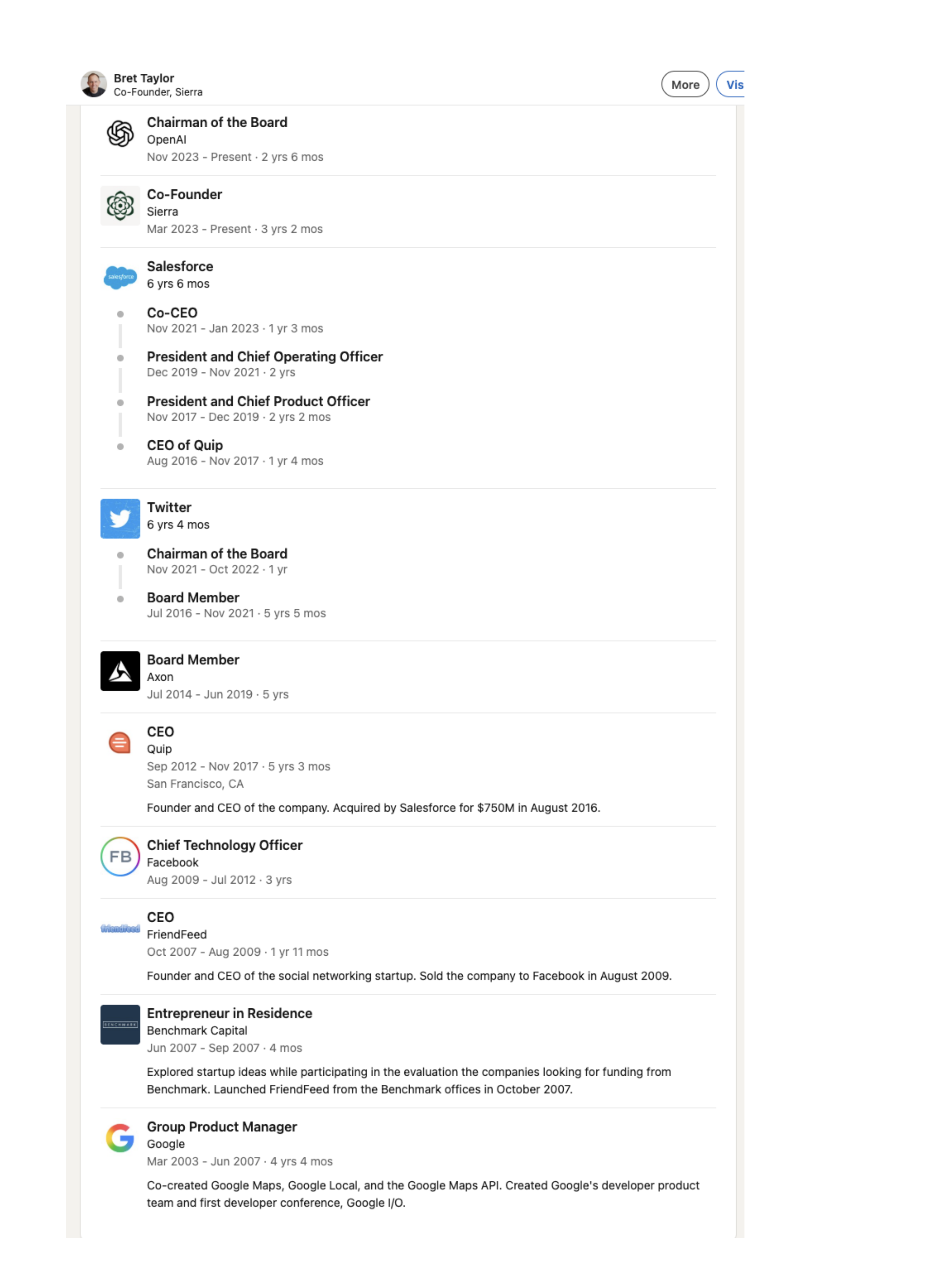
Bret Taylor is the founder archetype. Google APM, co-created Maps, then left after four years to start FriendFeed, a tiny company nobody remembers that happened to invent the Like button. Every move after that was a bet on curiosity over safety: Facebook CTO, Salesforce Co-CEO, OpenAI Chairman, Sierra co-founder. The through-line is that he kept choosing the most interesting problem he could find. He probably recognized early on that his gift was building, that he was an entrepreneur at his core, and optimized for that.

Asha Sharma is the ladder archetype. Porch COO, Meta VP of Product, Instacart COO, Microsoft President of CoreAI, CEO of Xbox, never staying anywhere more than four years. As one observer put it: not a founder type all emotional about products and missions, just ruthless evaluation of options and highest trajectory paths. The through-line is that she kept choosing the steepest learning curve and the biggest scope available to her. She probably recognized early on that she was very good at big-company politics, at being a power player in complex orgs, and leaned into that as her edge.
Looking from the outside, it seems like almost always one of these two. And despite looking nothing alike, both share the same principle: neither optimized for title. Taylor optimized for the quality of the problem. Sharma optimized for the rate of growth. Both are forms of optimizing for learning, just expressed very differently.
Which one you are probably depends on things about yourself that are hard to change. The practical implication is the same either way: get one good name on the resume, the entry fee that opens the lock, then go wherever the learning rate is highest. The prestigious internship is not the room you want to live in. People consistently overvalue near-term rewards and get trapped on a local maximum. Early in your career, the steepness of the curve and the quality of the people around you matter far more than whether your title says "Product."
What to do about it
Most APM programs are far more fragile than they appear. They exist because individual champions lobby for them, and they die when those champions leave. LinkedIn killed theirs in 2025. Twitter killed theirs after Musk. Meta froze theirs during layoffs. If your career strategy depends on getting one of twenty spots at one of eight companies, you are building on a very unstable foundation.
The alternative is proof of work. Do you have something online right now, a website, a blog, a shipped project, anything that shows how you think about products? If not, you're in the majority. Almost nobody does. That's the gap, and it's also the opportunity.
The PM resume is a commodity. Everyone has the same bullets. Prestige follows the law of diminishing marginal returns: your first big name does eighty percent of the work, the second adds fifteen, and by the third you're grinding for single-digit gains while someone else built an actual product and developed real judgment in the process.

A few years ago I did a take-home writeup about a product I liked and how I'd change it. I wrote about Curius, a Chrome extension I use for saving and highlighting things I read. Today I not only still use it, I've actually been shipping some of the features I'd originally only written about. Rather than presenting product visions in a Google Doc, I was able to act on them. That's the actual proof of work: not "familiar with AI tools," which is 2026's "proficient in Microsoft Office," but here's something I built, here's what broke, here's what I'd do differently. You can't fake that signal. And right now there is more opportunity to produce it than at any point in history. Claude Code, Cursor, Replit, Bolt, Lovable: you can build a real product in a weekend with zero engineering background, which wasn't possible three years ago. It won't be scalable or secure, and pure vibecoding without any understanding of what's happening underneath is a route to architectural disaster; but as a way to prove you can think through a product and ship something real, the barrier has never been lower. The barrier isn't access. It's initiative.
Drop the interview prep maxing. Take the side door. Build like crazy, and when you do interview, win by reasoning from first principles rather than reciting frameworks. Frameworks are training wheels, useful your first week on the job but actively preventing you from developing the reasoning muscle that matters. The PM who can think through a novel problem from scratch will always beat the one who reaches for RICE or CIRCLES. The best way I know to build that muscle is to build things, break things, and reason through the wreckage.
Agency
All of this, the lateral moves, the building, the side doors, requires a specific kind of willfulness that most people lack. Not talent, not intelligence. Something closer to a refusal to wait for permission.
Cate Hall's essay "How to Be More Agentic" changed how I think about careers. Her core argument: agency isn't an innate trait, it's a learnable skill. The highest-leverage move isn't working harder. It's exploiting edges that other people avoid because of social friction, fear of rejection, or simple unwillingness to look stupid in public. Court rejection. Assume everything is learnable. Accept being bad at something where people can see you. Meet broadly without trying to predict who will be useful later.
Be honest with yourself about the herd you're running with. The conventional herd pushes you toward big-tech titles and name-brand companies. The contrarian herd celebrates dropping out and raising money as if that were inherently virtuous. The way I think about it, what matters is whether you arrived at it through genuine reflection rather than social gravity. If you index on how a decision is perceived by your peer group, you offload your thinking and surrender your agency, which is precisely what this entire essay argues against.
Most "just build things" advice assumes you have a safety net. For international students especially, the calculus is different: a failed startup isn't just a learning experience, it's a visa problem. That variable doesn't change the argument, but it's worth naming.
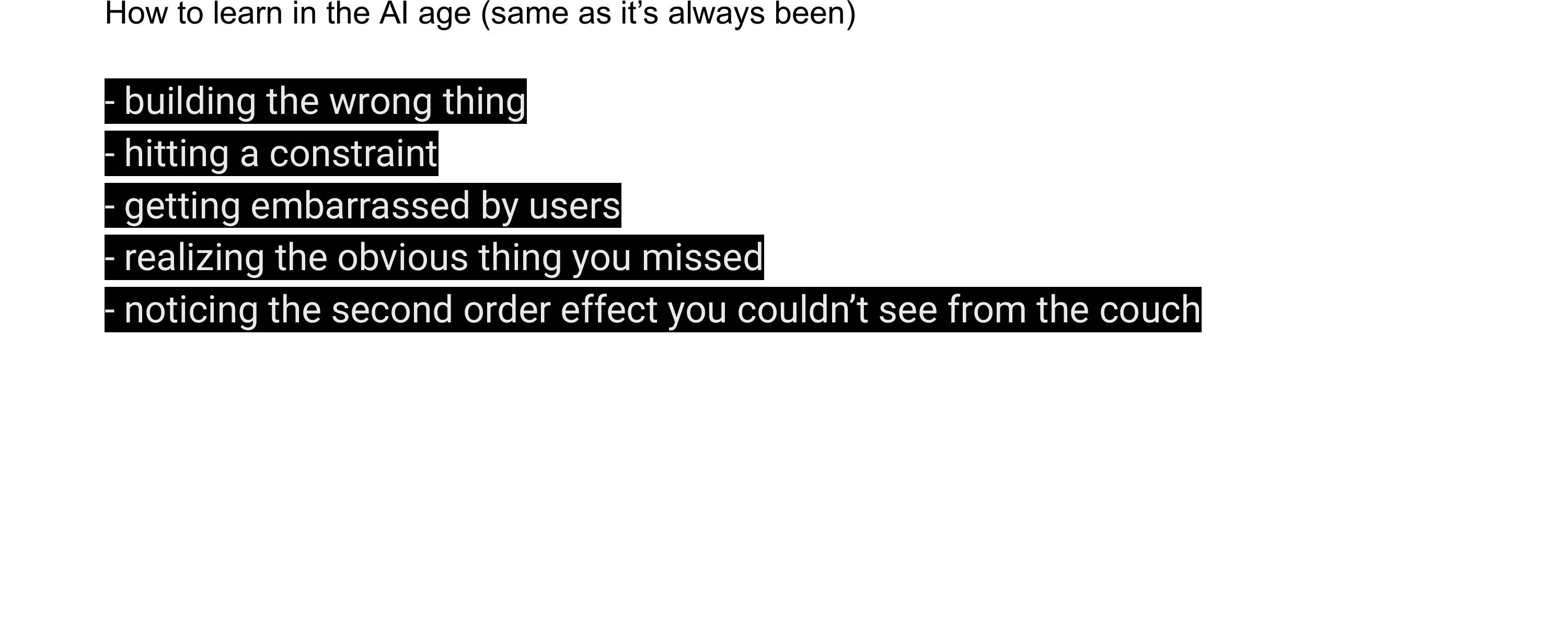
None of the learning that matters comes from reading. The reading gives you vocabulary, a way to name things you've already felt. Reality gives you knowledge.
The path forward is more open than ever. And unlike case-study prep, it rewards the stuff that actually interests you: the strange electives, the side projects, the rabbit holes, the things you do because you can't help it.
Things that shaped this piece
- Gurwinder, The Intellectual Obesity Crisis
- Peter Yang, Why Is Everyone Hating on Product Managers
- Chris Dixon, Climbing the Wrong Hill
- Sam Altman, How to Be Successful
- Pete Koomen, Horseless Carriages
- Max Goodbird, Causal Explanations Considered Harmful
- Paul Graham, Good Taste
- Jacky Zhao, Aesthetics and Taste
- Cate Hall, How to Be More Agentic
- LessWrong, Liquid vs Illiquid Careers